
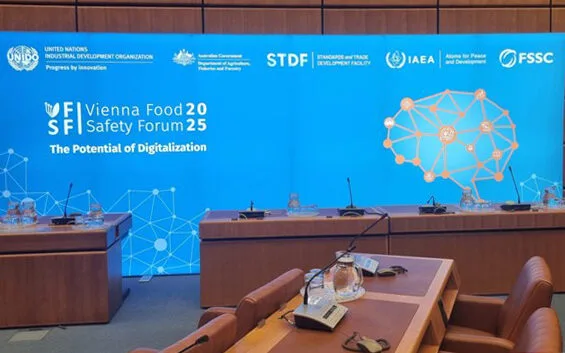
UNIDO headquarters in Vienna hosted over 300 participants from more than 75 countries with one shared mission: to explore how digital transformation can reshape the future of food safety globally. This an example.
These three days (June 10–12) were packed with discussions, panels, and workshops, but what stayed with us most wasn’t just the presentations; it was the recurring call for “connection”.
Not just digital connection, but human connection.
Systems talking to each other.
People understanding one another.
Insights moving across borders.
The Systemic Gaps We Can’t Ignore
The opening keynote by UNIDO was both sobering and honest. It laid bare the challenges we all know too well: limited resources, complex regulatory environment, and the growing digital divide. But the word that echoed most powerfully in the room was interoperability. Again and again, we heard that digitalization isn’t about having more tools; it’s about linking what we already have—and building trust across those links.
One high-level official highlighted the performance struggles many systems still face, whether in infrastructure, expertise, or policy alignment. It struck a chord with us. We often talk about innovation, but how often do we talk about the basics being under strain?
Technology Amplifies, It Doesn’t Replace
One speaker, from a regulatory authority, shared how they’ve started using large language models (LLMs) and computer vision, not to replace people, but to support them. We loved that perspective. For example, computer vision is now helping spot allergen labeling issues, which are still the number one reason for product recalls. This kind of technological support doesn’t remove human judgment; it extends it.
But technology doesn’t fix broken systems. That came through clearly when trade representatives pointed out how regulatory fragmentation, limited data access, and outdated infrastructure can still paralyze progress. A few voices stressed the importance of building internal digital capabilities rather than outsourcing everything. The logic is simple: if you own your system, you’re more likely to connect and scale it.
Beyond Data: Fusion, Trust, and Behavior
One of the most thought-provoking ideas we took away was the concept of data fusion. It’s more than just digitizing records; it’s about weaving together data from labels, audits, supply chains, and inspections into one meaningful picture. This “fusion” is what turns information into insight.
But technology won’t work without trust. Several speakers stressed how trustworthy data sharing, especially when anonymized and aggregated, is essential for progress. And trust, we were reminded, is something we earn slowly, not something we code into a platform.
There was also a healthy skepticism in the room about shiny new technologies that never get used. One participant almost called it the “digital initiative graveyard.” Too often, we focus on tools, not people. Without attention to how humans think and behave, even the best technology fails.
That led to another key point: behavioral science must go hand in hand with data science. We can’t roll out new systems and expect them to work without understanding the workflows, habits, and decision-making styles of the people using them.
Real Stories, Practical Lessons
We were especially inspired by real use cases shared by authorities: remote audits powered by integrated data, AI-enhanced inspections, and label scanning at scale. These weren’t dreams; they were already being tested. But even they came with caveats: the data wasn’t always clean, systems weren’t always aligned, and the technology needed humans at the center.
One comment captured the moment for us: “Don’t ask for perfection, ask rather for connection. Focus on interoperability in action.” It reminded us that progress doesn’t come from having it all figured out. It comes from moving forward with what we’ve got and learning as we go.
What We Are Taking with Us
Here are the lessons we brought home with us:
- We must invest in people. Training, infrastructure, and capacity-building are foundational. Without them, tools are just noise.
- Connection beats perfection. If our systems can’t speak to each other, no amount of digitization will help.
- Data fusion is a game-changer. Seeing the whole picture—across functions, systems, and borders—is what makes modern food safety possible.
- Trust must be built. Not just in data, but in institutions, systems, and each other.
- Technology must work for people. Understanding behavior, workflows, and resistance is just as important as coding algorithms.
- AI should have a purpose. Tools like LLMs and computer vision only work if supported by clear goals and solid data foundations. We may not need AI for everything.
As we reflect on the forum, we keep returning to a line from Bayezid-i Bestami, the Sufi mystic: “Truth cannot be found by merely searching, yet only those who search can find it.”
That, to us, is what digital transformation in food safety is about. We can’t see the end from where we stand. But by taking the first steps, connecting, building, and learning, we move toward systems that protect food and empower the people behind it.
Thanks to all the organizers, moderators, presenters, and participants for this fantastic event.