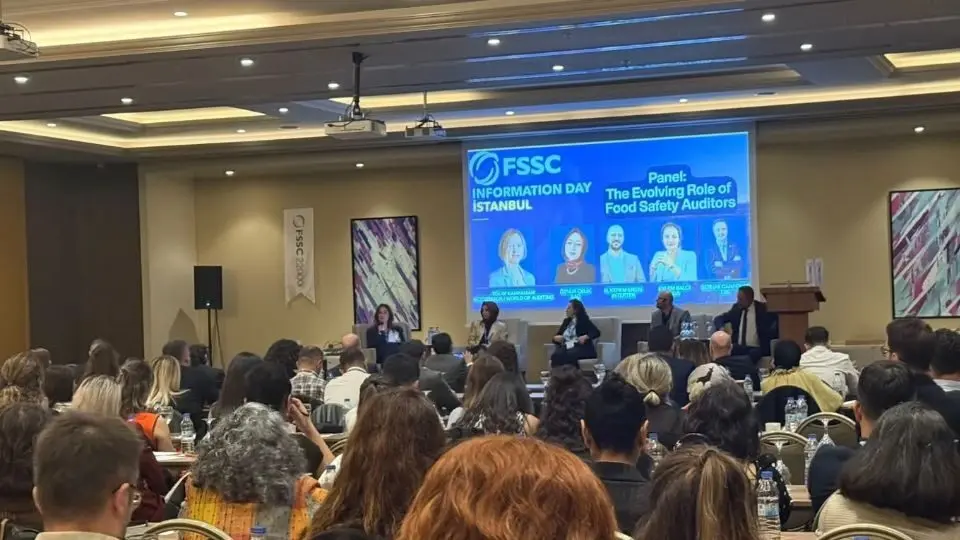
Last week, World of Auditing had the privilege of moderating a panel discussion at FSSC Day Istanbul 2026, where a distinguished group of auditors and certification professionals explored the future of food safety auditing. The discussion closely aligned with findings from our recent global research on the future of food safety audits and the auditing profession, making for a particularly insightful conversation.
One message emerged clearly throughout the session: food safety audits remain highly valued, but expectations are growing that they should deliver even greater value. This shift is gradually reshaping both auditors’ roles and the expectations placed on them.
The panel began by reflecting on how the profession has evolved over the past decade. Auditors today operate in a significantly more complex environment. Supply chains have become increasingly global and interconnected, stakeholder expectations have risen, and food safety risks are evolving faster than ever. At the same time, auditors face growing administrative and documentation requirements, which often limit the time available to focus on higher-value audit activities. Our global research also reflected these challenges, with auditors repeatedly citing workload, time pressures, and the need for greater recognition of the profession. Yet, panelists noted that this evolving landscape also creates opportunities for professional growth. Higher expectations from organizations and stakeholders are driving auditors to keep expanding their expertise, adopt new competencies, and adapt to an increasingly dynamic environment.
The discussion then turned to a fundamental question: what makes an audit truly valuable?
Panelists agreed that while compliance remains essential, organizations gain the most when audits provide meaningful insights that strengthen systems and improve performance. A successful audit should leave an organization with greater clarity about its risks, opportunities, and priorities. However, achieving this requires effort from all parties involved, including auditors, certification bodies, scheme owners, and the audited organizations themselves. In many ways, the future of auditing depends on moving from a mindset of verification alone towards one of value creation and continual improvement.
Perhaps the most thought-provoking discussion centered on the future auditor. Technical knowledge was universally viewed as a prerequisite, but no longer as the sole differentiator. The panel emphasized that communication skills, critical thinking, curiosity, systems thinking, and the ability to build constructive dialogue with organizations will become increasingly important. As food safety systems grow more sophisticated, auditors will need to connect information from multiple sources, understand broader business contexts, and constructively challenge assumptions. These human capabilities are becoming just as important as technical expertise.
Naturally, technology and artificial intelligence became central to the conversation. The panel recognized the enormous potential of digital tools to improve efficiency, data analysis, trend identification, document review, and audit preparation. Auditors could automate or significantly streamline many repetitive administrative tasks that currently consume their time. The ability to effectively leverage emerging technologies and AI-driven solutions is expected to become an increasingly important component of the auditor’s skill set.
One of the strongest takeaways was the consensus that professional judgment will remain fundamentally human. Technology can process vast amounts of information, identify patterns, and support decision-making. AI can help auditors become more informed and more efficient. Yet auditors cannot delegate to an algorithm the ability to interpret context, assess organizational culture, evaluate behaviors, challenge inconsistencies, and make balanced judgments. Food safety audits involve far more than assessing documented systems; they require understanding people, observing operations, and evaluating the realities behind procedures.
Rather than replacing auditors, AI will likely amplify the impact of those who use it effectively. The auditors who thrive in the future will not necessarily be those with the deepest technical expertise alone, but those who can combine strong professional judgment with the intelligent use of digital technologies. In this sense, AI should be viewed not as a substitute for human expertise, but as a tool that enriches it.
If there was one overarching takeaway from the discussion, it was this: the future belongs to neither humans alone nor technology alone. It belongs to auditors who can combine both successfully. As digital capabilities continue to advance, professional judgment, critical thinking, and human insight will become more important, not less.
The role of the food safety auditors is evolving, but its essential purpose remains unchanged: helping organizations build confidence, manage risk, and continuously improve in an increasingly complex world.